Pretty much the most interesting blog on the Internet.— Prof. Steven Landsburg

Once you get past the title, and the subtitle, and the equations, and the foreign quotes, and the computer code, and the various hapax legomena, a solid 50% English content!—The Proprietor

Wednesday, September 30, 2015

Thinking Like a Lawyer

law school reading room

One of the promises made to students as they enter law school is that one day during their sojourn there, they will have an epiphany and grasp what it means to think like a lawyer. It is on that day, and no earlier, that they will cease to be mere law students, but become novice lawyers.

An Unwelcome Privilege

unbalanced scales

The existence of an effective, binding, civil justice system has two implications for you. The first of these is that, should somebody legally wrong you, you can sue them. The second is that, should you legally wrong somebody, they can sue you. This is often thought of as a cost-benefit balance. The capacity to sue is great, but being sued can be unpleasant. You take the bitter with the sweet, because on balance the latter outweighs the former.

That is incorrect. For both of these implications are benefits to you and, for most people, most of the time, the capacity to be sued is a far greater benefit than the capacity to sue.

The Current U.S. Immigration System Is the Best That Can Be Hoped For

The titular proposition, not endorsed by any politician or commentator the author is aware of,The closest parallel are some remarks unsurprisingly by Milton Friedman: Now, that Mexican immigration, over the border, is a good thing. It’s a good thing for the illegal immigrants. It’s a good thing for the United States. It’s a good thing for the citizens of the country. But, it’s only good so long as its illegal. is a peculiar one to be advanced here for reasons both personal and principled.

How to Easily and Cheaply Stop and Reverse Illegal Immigration

illegal immigrants

Exchanges may be mutually beneficial and yet never occur because of the Prisoner’s Dilemma. If one party can costlessly renege on its promises after the other party has performed, the observed equilibrium will often be universal defection without any mutually beneficial cooperation. One of the greatest benefits of laws and courts is that there mere potential of suing for breach of contract is enough to move us to the cooperative equilibrium without even requiring very many such suits.

Tuesday, September 29, 2015

The Intelligible Argument Against Citizens United

Justice Breyer

It has been noted, both here and elsewhere, that the popular bumper sticker arguments against the Citizens United decision—Money Isn’t Speech! and Corporations Have No Rights!—are legally ludicrous and would not be made by any competent constitutional lawyer.

Saturday, September 26, 2015

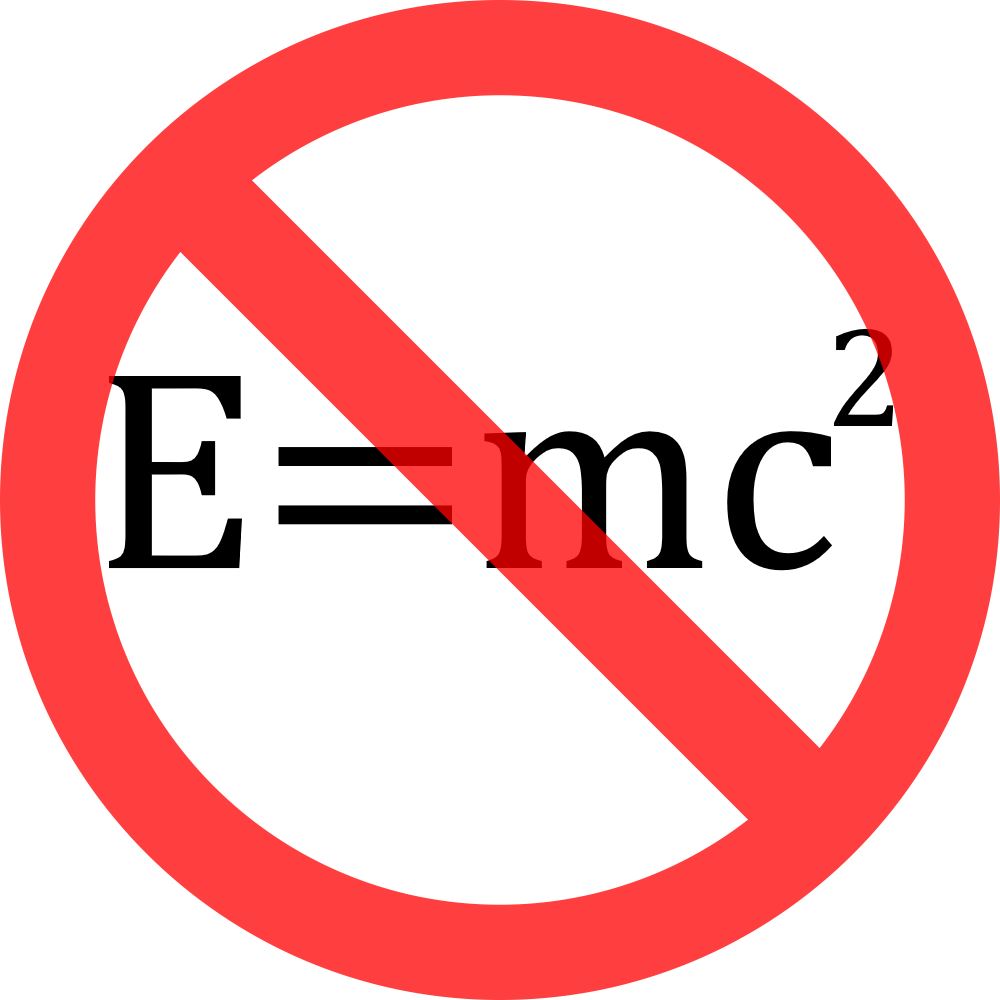
E = m c2?

E Not = m c 2

The titular formula is to many both the epitome and sum total of modern physics. It is regarded as the peak of human genius and the blueprint of the nuclear bomb.In some of these description, superlatives and awe seem to substitute for understanding. Surely, it covers blackboards in the lecture halls and offices of all reputable physics departments.

But surprisingly it does not. Even more surprising is the reason: this equation is universally agreed to be hogwash when the variables are interpreted in the way modern physicists find most convenient.That modern physicists know that \(c=1\) is a secondary reason for it merely renders the equation excessively verbose, rather than flatly wrong.

Is There Only One Electron?

electron positron annihilation and creation

Update October 26, 2015: A very good Pop Physics/Mathematics lecture by Prof. Robbert Dijkgraf The Unreasonable Effectiveness of Quantum Physics in Modern Mathematics is youtubed here. From about minute 19 to minute 22, Dijkgraf explains and offers some history on the theory discussed in this post, albeit without offering an answer to the reason the theory is rejected here. The whole thing is highly recommended as both accessible to the interested layman and offering some amusing details to the professional.

Note: This post contains a strong hint regarding the author’s proposed answer to a puzzle he once posted.

There is an amusing, if probably ultimately flawed, theory that seeks to explain the remarkable fact that of all the \(10^{80}\) or so electrons or so in the observable universe, every single one appears to have exactly the same mass and charge. Moreover, all the positrons (i.e., the electron’s anti-matter twin) also seem to have exactly the same mass and exactly opposite charge.

Sovereign Immunity as Irrebuttable Evidentiary Presumption

Thomas Wentworth, Earl of Strafford

The ancient doctrine of sovereign immunity to this day frequently shields the king’s men from legal liability for acts on his behalf. But this was not always how the doctrine was interpreted. Rather it was at times interpreted as an irrebuttable evidentiary presumption that the sovereign himself (i.e., the king) could not have formed a criminal intent. Under this view, the sovereign, no matter what the other evidence may say, will never be guilty of a crime.

It is in this form that the doctrine was on at least one celebrated occasion used not as a shield for a man of the king, but—in a gloriously perverse legal twistSo glorious that the author’s heart beats higher on reflecting that shares he with the authors of that twist the appellation of attorney.—as a deadly sword against a high-ranking king’s man.

Friday, September 25, 2015

The Lunacy of France

Anatole France
In its majestic equality, the law forbids rich and poor alike to sleep under bridges, beg in the streets and steal loaves of bread.«La majestueuse égalité des lois, qui interdit au riche comme au pauvre de coucher sous les ponts, de mendier dans les rues et de voler du pain.»

This quote of Anatole France’sThis page of the Nobel Laureate’s most famous quotes is well worth reading to the connoisseur of well-spoken lunacy. For example, it was not the Marquis de Sade, but France who said that Suffering—how divine it is, how misunderstood! We owe to it all that is good in us, all that gives value to life; we owe to it pity, we owe to it courage, we owe to it all the virtues. is often cited as profound critique of the concept of neutral law applying equally to all without regard to status. It is said to rip the mask of hypocrisy from that notion and expose it for what it is: a mere rhetorical whip wielded by the 1% against the rest of us.

Today’s Speed of Light Is 1.5180 Dollars per Pound

Feynman diagram of photon/photon scattering

An article on pop physics, reportedly written by a retired Emory physics professor, is not entirely without merit or value, but it hangs itself of, and by, its subtitle question:

Light travels at around 300,000 km per second. Why not faster? Why not slower? A new theory inches us closer to an answer

To an interested layman this may seem a valid or even intriguing question. It is not.

Just Write!

Common-place, yet one thought sound, advice frequently given to aspiring authors:

Just write! Put words on paper or screen and share them with whoever may be willing to read them.

Do not allow yourself to be worried about imperfection. For that will only ensure that you never write.

Perfection, should that ever become a necessity, can wait until such time.

Such advice is more readily dispensed than followed. But the volume and imperfection of these pages in recent weeks should attest that the author at least made a valiant attempt to do so.

The Doppelgänger

Doppelgänger

Robin Hanson teaches economics at GMU. The author considers him to be something like a far more accomplished doppelgänger, for:

Taxes on Income, Red and Green

Red and Green Dollar

Prof. Landsburg recently posted a draft of his contribution to a FestschriftThe reader is urged to read the whole thing because, quite apart from the subject of this post, it has much news even for some who fancy themselves well-informed on the subject. For example, the author, while a reader and admirer of both McCloskey and the Greats of the Chicago School, had not known that he (as she then was) had been such a prominent and electrifying figure in it. for Prof. McCloskey:

Journalists—even bright and thoughtful journalists like Michael Kinsley—frequently justify the taxation of capital income with an appeal to the principle that everything ought to be taxed equally.

The notion of a general principle that everything should be taxed equally is pure blather, of exactly the sort that McCloskey warned us against at every turn. And if there were such a principle, it would still be incumbent on us to figure out exactly what the principle entails before jumping to any conclusions.

Thursday, September 24, 2015

Why the Author Is a Lawyer, Not An Economist

Richard Epstein and Angie Harmon

The titular question is one sometimes asked of this author. For it was through his interest in economics, including the reading of the works of the economist depicted on the left, that he first had an inkling that law might be a suitable profession.The works of the other person depicted also admittedly had an influence. While the author many years later had the good fortune to meet and work with the person on the left, he has not been so fortunate with respect to the person on the right.

Ancient Liberties

Roundheads and Cavaliers

The Great Schism which, to this day, splits political views across the English-speaking world and elsewhere, first arose in England when technological and social changes, perhaps inevitable, threatened to make the king (or, to say the same, the government) over-powerful. Those who take the side of the king and government in this centuries-long struggle were called at times and places Royalists, Cavaliers, pre-modern Tories, Progressives, Socialists, or even, bizarrely as they are in today’s North America, Liberals—all of these terms map onto each other with reasonable, if imperfect, accuracy. Those who took the other side were called at times and places Anti-Royalists, Roundheads, Whigs, Liberals, or, equally bizarrely, Conservatives.This does make it particularly galling to hear the most successful leader of the Royalist side in the U.S. history denouncing the resistance as Economic Royalists.

Genius and Insanity

Mad Hatter

One even somewhat familiar with the biographies of many of mankind’s greatest geniuses will be struck by the observation that an alarming fraction of them seem to have exhibited symptoms of mental illness, frequently quite severe. One need but think of Cantor, Frege, Nash, Landau, or Gödel.Newton’s name too probably belongs on this list.

The Perils of Memory

brain

The author has found that the secret of having a well-stocked memory is to read and experience widely but, preferably, not to take notice of anything unimportant or, if that is unavoidable, to forget the unimportant as quickly and completely as possible.

This method is effective, but poses a substantial risk. For when and where one has read or seen a thing is surely unimportant and to be forgotten. But later, a vaguely remembered idea or concept may arise in one’s thoughts in a manner subjectively indistinguishable from discovering it oneself.

This has, on more than one occasion, led the author to embarrassment.

Wednesday, September 23, 2015

Ascendancy

Over the last year, in his spare moments between work and posting here, the author has been working on a game called Ascendancy of which he has been thinking off and on for the more than twenty years since he played Rich Skrenta's Olympia. It surely has no mass-market appeal, for it is no Farmville or even Dark Souls. Rather it appeals to a specialized taste for something like a grander scale Minecraft plus a bit of RobotWar minus the graphics.

But it occurs to the author that this is a specialized taste quite possibly shared by some of the readers of this blog. So he directs such gentle readers to the complete manual. The prototype code is nearly complete, but there is still much of work to be done with filling out the database; a task that could continue indefinitely. The comments and suggestions (including whether they would consider playing Ascendancy) of any reader are eagerly solicited in the comments section to this post.

The Best Part About Hitting Oneself in the Head with a Hammer

hammer

There is a fad, which the author was surprised to find even friends one otherwise respects to be engaged in, of natural childbirth. By that is understood to be meant a voluntary choice to give birth in the same manner our prehistoric ancestors did—without sophisticated medical assistance or pain relief. As one is reliably informed that human childbirth generally involves at least hours of substantial pain, and sometimes days of excruciating pain, one is rather surprised that any woman would volunteer herself for this ordeal. But whenever one inquires into what might motivate such a strange choice, one hears a variation of one or more of the following:

Continued Fractions Are Interesting

Farey Diagram

Continued fractions can be readily understood using only elementary mathematics, but they have many applications in solving problems in higher mathematics, such as Pell's equation. Yet, even many with more advanced mathematical training are only vaguely familiar with them.

Tuesday, September 22, 2015

Ultrafinitism Is Interesting

Norman Wildberger

Lately one has been trawling YouTube for lectures on subjects in higher mathematics, physics, computer science, and economics. These lectures, like the ones from MIT OpenCourseWare (generally excellent, but limited), can be run in the corner of one's screen to refresh one's recollection, or perhaps even learn new ideas not covered in one's student days, while performing other tasks which do not require total concentration. In this course, one ran across the productions of one Norman J. Wildberger.

Monday, September 21, 2015

Administrative Notes

A few changes have been made to this blog that may be of interest:

  1. Readers interested in the content of the blog, but understandably unwilling to check the page frequently to discover when there has been one of the admittedly sporadic additions, can now subscribe via e-mail on the form in the right column. In addition, readers have always been able to subscribe to the full RSS feed.Caveat to readers using either e-mail subscription or RSS feed: The blog often contains typographical features, like equations or footnotes, which do not translate well into those formats and may appear as gobbledygook. Also, the author frequently edits posts after publication: to correct orthographical errors or solecisms, or to add explanatory footnotes or illustrations (but never to retract statements; in retraction is called-for, it will be in a new post). In those cases, it is recommended that the reader visit the actual blog where things display correctly and completely. E-mail and RSS subscriptions are still perfectly useful for other posts or as notifications that something new has been added.
  2. There is now a blogroll, also in the right column. Listing of a blog there indicates no more or less than that the author regularly reads it and recommends it to his readers. It does not imply that the author endorses all, or even most, of what is posted there.
  3. As part of these changes to the blog layout, the blog appears to have switched back to Blogger, rather than Disqus, comments. That was not the author's intention and comments appear to have returned to Disqus now. The author apologises to any commenters whose words were misdirected to Blogger comments and are now invisible. The author is diligently working on a solution to transfer all of these Blogger comments to Disqus.

Sunday, September 20, 2015

Political Correctness and Hyper-Straussianism

Leo Strauss

There is a Straussian school of textual interpretation named after its founder, Leo Strauss, and which forms part of a larger framework of Straussianism.

At the core of Straussian interpretation is the insight, often forgotten by modern readers, that past thinkers, like Socrates, often lived under conditions which would have rendered some conclusions dangerous to state. The ruler or the religious establishment may take offense to some conclusions and punish the thinker should he openly state them, as indeed was the cause of Socrates' death.

Of Marriage, Taxes, and Punching

punching fist

Imagine a genie were to appear before you and offer a deal along the following lines:

If you accept this one-time offer, you will never have to pay income taxes at a marginal rate above that of the median tax-payer. Even if you earned millions and lived in a high-tax jurisdiction, like New York city or California, your total marginal income tax rate will remain at about the 10% the median tax-payer pays, rather than the 50% or 60% you might have to pay under current law in these jurisdictions.

But this deal also has a down-side: You will never be allowed to marry. Sure, you will still be free to cohabit with any person of your choice, procreate, raise off-spring together, and make any contractual arrangements that seem suitable to you and your partner. You, your friends, and others (such as your church) would even be free to call such an arrangement marriage. But the government never will.

The Sun Orbits Around the Earth

sun and earth

One commonSee, for example, here for the usually much more astute Ilya Somin embracing this fallacy. trope of reporting on the scientific illiteracy of Americans goes something like this:

When surveys ask American adults to pick between the statements (A) the earth orbits around the sun and (B) the sun orbits around the earth, a large minority of about 25% pick statement B, rather than the correct statement A. This proves how shockingly ignorant many Americans are of scientific issues.

That conclusion may very well be true, but the argument proves no such thing; rather, it is merely sneering of the semi-educated at the honestly ignorant.

Saturday, September 19, 2015

The Idea of My Year: Curry-Howard Correspondence

Curry-Howard Correspondence

Edited on September 20, 2015 to add footnote 4.

Curry-Howard Correspondence was first published in 1969, before the author was born, but the author only learned of it in the present year. That alone is enough to induce a desire to go back to everybody one has ever encountered, starting with one's mother and father, grab and shake them, and cry You knew I lived, breathed, thought! Yet, you allowed me to remain in ignorance that such beauty and cleverness existed. How could you have been so cruel and thoughtless? Regardless, it is the idea of the author's year. To rescue the reader from the purgatory that ignorance of Curry-Howard Correspondence is, let one make an inexpert attempt to explain it here.

Friday, September 18, 2015

Whose Side Are You On, Anyway?

Recent comments on abortion have provoked friends, acquaintances, and strangers alike to make the above inquiry and—in some of the less friendly instances—to imply that one is a renegade from a cause previously believed to have been shared. In the past, comments on climate change, immigration, homosexuality, crime, religion, and others, have caused similar responses.

One could, perhaps, just state one's ultimate conclusions—of which the author is in ample supply—add some venomous barbs for all who do not share them, and consider the job well done. Indeed, most commentary seems to fall squarely within that category.1

The Unconscious Violinist and More Realistic Hypotheticals

One argument—once very common, but perhaps less so today—in favor of an wide-ranging right to abortion was put forth by Prof. Judith Jarvis Thomson in A Defense of Abortion, said to be the most widely reprinted paper in the history of philosophy:

In Defense of the Sunk-Cost Heuristic

sunk ship

One of the perennial bugaboos of introduction to economics courses1 is the sunk-cost fallacy. The fallacy goes generally like this:

Wednesday, September 16, 2015

Abortion Should Be Between the Woman and...

While on a subject as conducive to reasoned and congenial debate as abortion, one might contemplate a position very commonly expressed by ostensibly moderate Pro-Choice politicians and commentators:

Now, I am not saying that abortion is a good thing. I just think that we should keep the heavy hand of the state out of it. The decision to have an abortion really should be between the woman, her partner, her doctor, and her priest.

This is apparently a position often taken to great success by politicians with mixed constituencies because it pleases the dimmer sorts of both libertarians (who applaud the denial of state authority) and communitarians (who appreciate the involvement of local groups, instead of mere atomistic individuals).

Tuesday, September 15, 2015

Not Everything Human and Alive Is a Human Life

One argument sometimes heard from intelligent, widely-read, pro-life advocates runs as follows:

A fertilized ovum is, by generally agreed definition, a living cell. Moreover, it contains the full set of genes which identify it as a human cell. Being human and living, it is definitionally a human life. Deliberately and without valid excuse causing the end of a human life is murder. Hence abortion is murder.

Drawing Borders in Sand

Line in the Sand

If one asks persons sympathetic to the causes of Arabs and Arab governments—a group including the vast majority of Western academics specializing in the subject—about the reason for the generally high levels of violence and poverty in Arab lands, one frequently hears a variation on the following theme:

Why Sub Specie Æternitatis?

In order to indulge my vanitysatisfy the insatiable curiosity of the clamoring masses, let me briefly explain why I chose this particular pseudonym. (The reason this blog is weakly pseudonymous was given below.) The author would like to say that it was his profound engagement with the thought of Aquinas, Spinoza, and Wittgenstein which inspired him to pick this particular nom de cyber. Sadly that would be a lie.

Monday, September 14, 2015

In Search of Fiction with a Particular Twist

This post requests the gentle and well-read readers' suggestions for fictions with a particular twist.

The fiction is most likely a short story or novel. It could be a movie, but due to the nature of the narrative that would be very difficult to do well. It is quite possibly genre fiction, most likely science fiction or mystery. As it relies on the trope of the unreliable narrator, it is unlikely to have been produced before the twentieth century.

Economic Illiteracy Grows at Twice the Rate of Inflation

A common trope in economics reporting is to claim that this or that figure had risen at some multiple, usually double, of the rate of inflation. For example, the New York Times reported:

The Paradox of the Lying Judge, Part 2

Cross Examination

Another post discussed what is commonly called the Paradox of the Unexpected Hanging. The conclusion was not that the judge might have been lying, even though he turned out not to be, and that the lawyer's argument is somehow flawed for not taking that possibility into account. The conclusion was that the judge most definitely was lying (or, used synonymously here, mistaken).

Sunday, September 13, 2015

The Paradox of the Lying Judge

man hanged backwards

In the discussions of the pirate puzzle an interesting point was raised when Robert Murphy of Texas Tech mused1 that there may be an analogy to what is conventionally called the Paradox of the Unexpected Hanging.

Saturday, September 12, 2015

How an Alien Can Predict Humans

economist alien

Imagine you were an alien come to visit the earth to find out what makes humans tick. The purpose of your mission is determine what the humans will do in the future and, in particular, if in time they are likely to become a threat to your civilization. If so, your civilization will put an end to the human one before it becomes a threat.

Thursday, September 10, 2015

Voluntary and Involuntary Unemployment

A recent post defined and used the term involuntary unemployment in the standard economic way. A person is involuntarily unemployed if and only if:

  1. The person is unemployed; and
  2. there exists a wage \(w\) for which that person would be willing to work; and
  3. there exists somebody else that would be willing to pay \(w\) for that person's services.

Tuesday, September 8, 2015

How Ferocious Pirates Divide Gold

Post updated on September 10, 2015.

Steve Landsburg, a mathematician and professor of economics, blogs at The Big Questions. The blog's position near the top of my daily read of hundreds of RSS feeds bespeaks the excellence of its content. Anybody who enjoys this blog would doubtlessly enjoy The Big Questions at least as much.

Today, Prof. Landsburg posted a mathematical puzzle said to have been given in Google job interviews:

Sunday, September 6, 2015

The Bullet in the Head

skull with gunshoot hole

A philosopher is a friend (or lover) of the Truth. One might think that this would be a curious distinction to claim as are we not all friends (or lovers) of the Truth and, hence, every man and every woman a philosopher?

Friday, September 4, 2015

A Philosophical Dialogue on Obligation (with Some Action)

drowning child

Two philosophers, A and B, taking a walk along a lakeside and debating their subject, when they notice a child apparently drowning in the lake. B is physically frail and cannot swim, but A is a strong swimmer and so immediately sets out to jump into the lake.

Wednesday, September 2, 2015

Monday, August 31, 2015

A Coda on the Periods Function

A recent post discussed the problem of a periods functions which, when given a potentially infinite list, will reliably determine whether that infinite list is periodic and, if so, with which parameters. It was claimed that a general strong periods function, which always works, is impossible because it would imply a solution to the unsolvable halting problem. Instead, a weaker, but still useful, periods function was offered that produces useful output, but does not terminate on infinite lists.

Wednesday, August 26, 2015

How to Eliminate the Capital Gain Deferral Distortion

And now for the thrilling conclusion of the blockbuster series of posts on the capital gain tax deferral distortion! We have seen how it arises, how some common-sense fixes cannot work, how bond taxation addresses it imperfectly, and how it can be exploited to shield even current investment returns from taxation.

More Fun With Capital Gains Tax Deferral

Recent posts have described how capital gains tax deferral allows investors to reduce their effective tax rate asymptotically to zero, how this distorts investment decisions, how market-to-market cannot fix the problem, and how bond taxation partially deals with the problem. Before the eagerly anticipated revelation how the tax code could fix this distortion to come in a future post, let me describe another method by which this deviation can be further exploited.

Testing Periodicity in Haskell

If you are dealing with infinite, but potentially periodic, series, you may sometimes have wished there was a function, let's call it periods, that could be given such a series and tell you whether it is periodic and, if so, the length and starting point of the period.

Sadly, such a function is impossible. There is no way for the function to determine whether any apparent period is genuine or there is a break at the \(n\)th element without looking at every single element. And checking every single element of an infinite series obviously cannot be done in finite time.

Tribonacci Coda in Mathematica

One question one might have after going through the Haskell Tribonacci problem is why it should be necessary to go through all that complication with recursive matrix multiplication in order to calculate such a simple function. Surely, one might say, there must be a mathematical formula into which you just plug in \(n\) and out pops the corresponding Tribonacci number.

Friday, August 21, 2015

How Bond Taxation Addresses the Deferral Distortion

A previous post discussed the economic distortion caused by deferral of capital gains tax, another, why market-to-market cannot fix this distortion. This post shows how the tax code tries, but does not entirely succeed, in addressing this issue with regard to bonds.

Tuesday, August 18, 2015

Tribonacci Function: Exercise in Elementary Haskell Optimization No. 2

This is the second entry in an intermittent series of posts on how to optimize some basic mathematical functions in Haskell. The previous entry is here.

Consider the following problem: A person is ascending a staircase with \(n\) steps. The ascendant is sufficiently tall and the steps sufficiently shallow that with each gait, the ascendant can take one, two, or three steps. How many different ways are there for the ascendant to reach the top?

Mandatory Mark-to-Market Cannot Fix Capital Gains Tax Deferral Distortion

A previous post discussed the issue of the deferral of capital gains tax and why, if there is going to be a capital gains tax, this deferral distorts economic decision-making. The issue of this post is whether mandatory mark-to-market taxation can fix the problem.

Monday, August 17, 2015

How to Cut Taxes When Congress Won't

Imagine a 2017 with a newly sworn-in President Paul (or Cruz), but a Congress no more and perhaps less conservative than the current one.

The President announces as one of his main legislative priorities a comprehensive reform of the tax system, including reducing the top marginal individual federal income tax rate from the current 44% or so to 25%. However, after extensive debates accompanied by great acrimony and perhaps a filibuster or two, Congress refuses to enact the President's tax reform.

Economic Distortion of Capital Gains Tax Deferral

One under-appreciated feature of capital gains taxation are the substantial implicit benefits of deferral—capital gains are only taxed once they are realized (i.e., generally when the investment is cashed out), not when in any economic sense they are earned. Effectively, deferral renders any sufficiently long-term capital gain tax-free, regardless of what the statutory rate is.

To understand this counter-intuitive—after all, aren't long-term gain still taxed before you can ever get the cash?— conclusion, consider the following hypothetical:

Sunday, August 2, 2015

Comments Shifted from Blogger to Disqus

I am experimenting with switching from the Google/Blogger comment system to the Disqus system, which in my experience as a commenter is quite superior.

One consequence is that the old comments have disappeared—worry not, your words have not joined Lois Lerner's e-mails. They just don't show up as Disqus comments because the software to export Blogger comments to Disqus is currently broken. As soon as that problem has been alleviated they will show up in the Disqus system.

Comments on comments very welcome.

Wednesday, July 22, 2015

Planned Parenthood Baby Part Sale Kerfuffle

Planned Parenthood, the nation's largest abortion provider, sells the body parts of late-term babies they aborted for medical research. A videos of a sting operation showing senior Planned Parenthood executives discussing such sales, including abortionists buying Lamborghinis with the proceeds, have been posted to YouTube. Predictably, Pro-Lifers are outraged and the mainstream media have either been ignoring the story or focused their outrage on the violation of Planned Parenthood's privacy.

Tuesday, April 14, 2015

What Matters and What Does Not about the Laffer Curve

The basic idea is that, if you plot the revenue generated by any given tax against its rate, you'll virtually always observe: (1) no revenue at a 0% rate; (2) no revenue at a 100% rate, and (3) between these rates the function is concave.

Monday, March 23, 2015

Quiz: Why Are There No Higher Voltage Lines?

High-Voltage Transmission Line

Note November 9, 2015: Commenters jonshea figured out my proposed reason.

Note: A hint to the proposed answer for this puzzle is offered by another, more recent post here.

Large amounts of electrical power are generally transmitted via high-voltage lines. The reason for this is pretty basic:

Friday, March 28, 2014

Eliminating the Mortgage Interest Deduction Would Not Make the Tax Code Fairer

One frequent point made by free-market types, such as myself, is that the tax code's many preferences and deductions make the tax code distortionary and result in unnecessarily high marginal rates. The prime example cited is always the mortgage interest deduction which is said to favor the well-to-do and cause house prices to rise too high. While the general principle is sound, abolishing the mortgage interest deduction is not necessarily a step in the right direction.1

Wednesday, March 19, 2014

Australia Does Retirees No Favor

Matthew C. Klein over at Bloomberg View argues that the most recent move does:

The biggest pension fund in Australia is planning to directly manage 30 percent of its assets by 2018, rather than outsource the task to expensive external managers who rarely justify their high fees with superior returns. This should help the fund cut costs and boost retirement benefits.

While the basic premise—actively managed funds usually don't justify their high fees—is correct, this proposed reform is likely to make things worse rather than better, at least for the putative beneficiaries, for two reasons:

Wednesday, October 2, 2013

Tim Worstall Gets Econ of Insurance Wrong

Tim Worstall is a British economic commentator with a free-market bent who writes for Forbes and the Adam Smith Institute. His usual beat is the economic fallacies of some other, less insightful British econ commentators and his denunciations to them are often highly amusing, if a little salty.

In a recent post on the economics of insurance, I think he screwed the pooch. He tries to explain why writing insurance which are unprofitable on insurance basis might still be a good business:

Sunday, August 4, 2013

Thank You, Citibank and Uncle Sam!

I live in a pleasant 9,000 sq ft, 8 bedroom house in Northern Virginia, about 10 miles from the White House and my work. Recently I refinanced the mortgage on this house. Let's look at the economic implications.

Thursday, May 30, 2013

The Tax Expenditure Which Dares Not Speak Its Name

One topic of frequent exhortation on taxes among progressive policy wonkeries, such as the Tax Policy Center, are tax expenditures, or internal revenue code provisions which reduce tax revenues below what they would otherwise be.

Tuesday, May 14, 2013

Primitive Christianity

I happened across this passage in my recent reading and, while it is well-known, the events of Fifth Century Alexandria bring to mind recent events in the history of another major Abrahamic religion and it bears quoting:

Friday, December 23, 2011

National Pride Note

If I may note, it appears that us Swedish-Americans, of all the national European ethnic groups, made the largest intellectual contributions to America on a per capita basis—not that the Jews, the Indians, and the Chinese haven't us beat handily. See Who's Who in Science.

PS: This of course calls to mind one of my favorite Milton Friedman anecdotes. When, as he frequently was, confronted by Swedish socialists who informed him that In Sweden, we have abolished poverty! he'd respond Well, so we have in America ... among Swedes!

Saturday, November 19, 2011

Another Portrait of this Author's Alter Ego

(H/T: Wikipedia)

Macaulay on Legal Ethics

We will not at present inquire whether the doctrine which is held on this subject by English lawyers be or be not agreeable to reason and morality; whether it be right that a man should, with a wig on his head, and a band round his neck, do for a guinea what, without those appendages, he would think it wicked and infamous to do for an empire; whether it be right that, not merely believing but knowing a statement to be true, he should do all that can be done by sophistry, by rhetoric, by solemn asseveration, by indignant exclamation, by gesture, by play of features, by terrifying one honest witness, by perplexing another, to cause a jury to think that statement false.
—Thomas Babington Macaulay, Francis Bacon

Saturday, July 30, 2011

Global Warming Addendum

One quick point, to add to my global warming summary from last month.

The constant references to CO2 as "dirty" or a "pollutant" both in popular discourse and in recent Supreme Court decisions is unscientific and rather annoying. Carbon dioxide (a) has been ubiquitous in the atmosphere for as long as there has been organic life, (b) is absolutely essential for the continued existence of organic, including human, life, and (c) is utterly harmless to humans (and all other forms of life) at current concentrations (or any level of concentration contemplated even in the most apocalyptic scenarios).

If CO2 is an atmospheric "pollutant," it is difficult to imagine what component of the atmosphere, including oxygen and water vapor, is not a "dirty" "pollutant."

Saturday, July 2, 2011

TSA vs. My Two-Year Old Girl

Daughter (2)

This blog post merely recounts one more encounter with the Transportation Security Administration. Like so many other reports, it is merely an anecdote, rather than statistical proof of the thuggish ways of that agency. Yet, it strikes me as at least as cruel as several other incidents that recently have gained national attention, so it might be worth posting and reading.

Wednesday, June 29, 2011

What If Roe v. Wade Was Overturned?

A question frequently ignored by both sides in the debates about Roe v. Wade,410 U.S. 113 (1973)—the Supreme Court decision which along with its companion case and successors found a nearly-unlimited Constitutional right to abortion on demand—are the practical consequences of its reversal.

Tuesday, June 7, 2011

Global Warming?

Ordinarily, I try to refrain from commenting on matters on which others far better qualified than I have already commented at greater length and with far greater authority. Hence, the low volume of this blog.

Saturday, April 30, 2011

Practical Advice: How to Circumvent the Wall Street Journal's Paywall

In a change of pace—Dalhia Lithwick hasn't written anything recently, has she?—here is a piece of practical advice for those of us who don't want to go through our work computers (or other sites which have a permanent subscription) to read the Wall Street Journal's pay-walled articles:

Most Wall Street Journal articles are hidden by a pay wall. Unless you are accessing the site from a computer that is recognized as paid-for by the Journal’s web servers, all you will receive for most of these articles is a “stub” of a paragraph or two. This is annoying if you are trying to access the Journal from your home computer and you do not have a personal subscription.

Fortunately, this block is easily circumvented. Google, in order to completely index a website—something the Journal and other newspapers places great value on—must have the entire content of the site available to it. Google in turn requires operators to return the same version of the website to browsers who click on a Google search link as they do when Google itself follows the link. So to get all of the Journal, one just needs to pretend that one found the article with a Google search.

This only takes a second. When you run across a “stub article” just copy the beginning of the stub (typically about thirty words, but usually picking the first paragraph does the trick). Then paste the stub into a Google search box and hit search. Usually the first article that comes up in the search is the full copy of the Journal article. If it is not, it usually will be a copy of the Journal article on another website. If necessary, one can ensure that one gets the official version by adding the string “site:online.wsj.com” to the Google search box before hitting search.

Update: The WSJ has apparently become wise to this workaround and will at some point only display stubs, even after Google searches described above. Their method is cookie-based, so it is easily circumvented. Just continue reading WSJ articles on another computer, on another browser on the same computer, or delete your wsj.com (and subdomain) cookies from your current browser for a fresh start.

Update 2: With at least the current version 12 of Google Chrome it is possible to block wsj.com (and subdomain) cookies using Options/Under the Hood/Content Settings/Cookies/Manage Exceptions..., thereby permanently solving the problem. This may make commenting on WSJ articles impossible, but you can always use a separate browser (or separate Google Chrome Profile) for that.

Wednesday, April 20, 2011

Dahlia Lithwick Is Not Very Principled, Either

As part of the ongoing series of posts demonstrating the dubious value of Ms. Lithwick's commentary to anybody in search of intelligent argument, here is another example.

As recently as last year, in the course of belittling Ms. O'Donnell's Senate candidacy, Ms. Lithwick—informedly, a law school graduate—deemed it advised to mock as "weird" the candidates views:

I have been fascinated by Christine O'Donnell's constitutional worldview since her debate with her opponent Chris Coons last week. O'Donnell explained that "when I go to Washington, D.C., the litmus test by which I cast my vote for every piece of legislation that comes across my desk will be whether or not it is constitutional." How weird is that, I thought. Isn't it a court's job to determine whether or not something is, in fact, constitutional? And isn't that sort of provided for in, well, the Constitution?

Decoding Christine O'Donnell, Slate (Sept. 22, 2010).

Setting aside the question of whether a bill's constitutionality should be the sole basis for a legislator's vote—surely there must be constitutional yet inadvisable bills: let's say incorporating Mickey Mouse into the flag of the United States?—it hardly seems remarkable that a legislator, who has sworn an oath to uphold the Constitution, should at least give some thought to the issue before voting.

But then Ms. Lithwick deemed any such legislative cogitation to be no less than in violation of the Constitution itself. Now, however, Ms. Lithwick informs us of the opposite conclusion, bewailing the fact that:

Gone are the days in which legislatures at least attempted to ensure state regulations conformed to the broadest interpretation of the Roe constraints.

The Death of Roe v. Wade, Slate (April 19, 2011).

So it appears to be Ms. Lithwick's position that it is weird and unconstitutional for legislators to consider whether the bills they are voting on are in violation of the Constitution itself, but a necessity for law makers to only advance bills which are in full conformance of recent and controversial Supreme Court interpretations of the Constitution.

If there is any rational basis for Ms. Lithwick's position other than a complete and unprincipled disregard for the Constitution except when useful as a stick to beat upon political opponents, it escapes this author.

Barack Obama's Advice to Investors: Buy High, Sell Low!

Well, that is not exactly what the President said, but it is its logical equivalent:

Obama blames speculators for high gasoline prices

ANNANDALE, Virginia — US President Barack Obama blamed oil "speculators" on Tuesday for soaring gasoline prices that risk weighing down the US recovery and could dampen his 2012 election hopes. "It is true that a lot of what's driving oil prices up right now is not the lack of supply. There's enough supply. There's enough oil out there for world demand," Obama said at a campaign-style event not far from Washington.

Commodity speculation is the purchase (or sale) of a commodity, not because you plan to use it (or you produced it and need to dispose of it), but because you expect that you'll be able to sell (or re-purchase) it at a later time for a higher (or lower) price. And—contrary to the instinctive reaction of a vast majority of the population of the United States and even an alleged sophisticate like the President—it is a social good.

A good speculator must accurately predict price movements (or, to be more precise, their probability distribution). To make a profit, they must buy when prices are low and sell when prices are high. But adding speculative demand when prices are low will tend to increase prices and adding speculative supply when prices are high will tend to decrease prices. In other words, successful speculation tends to even out price spikes and troughs, not cause them.

Successful speculation also helps market prices reflect longer-term trends and risks and indirectly causes physical storage (if possible) and investment decisions to be made which reflect and compensate for these factors rather than merely immediate demand.

Indeed, at some level, the Pres. Obama appears to understand this:

"The problem is, is that oil is sold on these world markets, and speculators and people make various bets, and they say, 'you know what, we think that maybe there's a 20 percent chance that something might happen in the Middle East that might disrupt oil supply,'" he said.

"'So we're going to bet that oil is going to go up real high.' And that spikes up prices significantly," said the president, who recently launched his reelection campaign.

That could conceivably be true. But it can only be a sensible investment strategy if these hypothetical speculators sincerely believe (and back with their own money) that in the 80 percent chance that nothing bad happens in the Middle East—these are the President's odds, but they seem a tad optimistic—the price of oil will fall by less than one quarter than the amount from the allegedly speculation-induced price that it will rise above that price if something bad does happen.

But in that case speculators have bought positive expected value insurance for oil prices and helped smooth them out (on average), rather than caused an irrational price spike for their selfish, greedy gain. The President (and the general population) should be thanking, not condemning, them.

The alternative hypothesis is that these alleged speculators are just not very smart and are messing with the market by making incorrect predictions about the risks of future price movements. But such bad speculators are also a social good. While they may cause market volatility, they effectively give away their money to other market participants by selling low and buying high. And eventually they go out of business as they run out of capital.

When Pres. Obama accuses the speculation of malefactors of great wealth of responsibility for high oil prices, he must assume that they are all bad ones. That leaves the question of why he does not believe that the "problem" will solve itself.

Not that the opposition is much better:

Obama's Republicans foes have pounded him over the rise in fuel prices, accusing him of putting on hold new oil drilling that could eventually lead to lower prices.

Increasing U.S. oil production may or may not be a good idea. To blame the unavailability of the relatively small amounts still to tapped domestically for day-to-day or even year-to-year movements in the global oil markets is inane.

Wednesday, April 13, 2011

Macaulay—What a man! (Second Try)

As promised, please find quoted below, translated into HTML, and with some of the most obvious typographer's mistakes corrected (for the remainder the typographer and I shall accept joint and several liability), the McLuhan essay on Macaulay mentioned in yesterday's post.

Macaulay—What a man!

By Marshall J. McLuhan

It will be recalled that Arnold once said, "Posterity alarmed at the way in which its literary baggage grown upon it, always seeks to leave behind it as much as it can, as much as it dares." In late years Macaulay has lost favor with Posterity, his capricious palladium, and indeed it is rumored that due to the recent acquisition of a huge mass of "baggage," Macaulay must go. This is not "a consummation devoutly to be wished."

The perpetuation of Macaulay's place depends upon his younger readers. His life and writings are preeminently qualified to attract, fascinate and instruct the impressionable adolescent. As a scholar, conversationalist, orator, statesman, essayist and historian, he has few peers. The enthusiasm, profound good sense, learning, and mental power that he brought to bear upon every situation make him an inspiration to anyone that has a spark of verve in him.

Let us briefly regard his life. Very few lives indeed can equal for industry, usefulness, purity or interest that of Macaulay. In his biographer he was extremely fortunate. Trevelyan has produced a book that, after Boswell 's, stands in the very first rank. There is a natural curiosity on the part of everyone to observe renound and eminent men in their intimate relations with their fellows. Excluding Boswell and Pepys I know of no book that satisfies this curiosity in a more profitable, healthy, or less Stracheyfied manner. Few ages in any history offer greater interest from political, literary or social standpoints than the reign of Victoria. These three aspects are unfolded before us in a delightfully intimate fashion. We are taken behind the scenes during the intense and critical days that preceded the passing of the great reform bill. The fall of governments, ministeries in the making, and bitter debates are often described by Macaulay's own pen. Nearly every important literary man of that fertile era is either presented to us in person or is directly alluded to. And we see the relations and understandings which existed between several great journalists and their editors. Perhaps the social side is most interesting of all. It was an age when the cultivation of wit and brilliant conversation reached its peak; and when breakfast parties, levees, great dinners, musicales, and fancy balls, occurred in endless sequence. Many of these affairs are described in faithful detail by Macaulay in his correspondence. During his first burst of popularity Macaulay took advantage of his many invitations and was for several years the brilliant ornament of a brilliant society. His taste for these affairs slackened, but not so his popularity.

It would not be profitable in so brief a sketch to expatiate upon Macaulay's precocity. His bon mots, the fact that he wrote a Compendium of Universal History when he was seven, and that he had a remarkable memory, these are impressions held by many Who know little else concerning him. Listen to an extract from a letter written to an anxious parent. Macaulay was fourteen and in attendance at Mr. Preston's school.

"I am sorry to hear that some nameless friend of Papa's denounced my voice as remarkably loud. I have accordingly resolved to speak in a moderate key except on the undermentioned occasions. Imprimis, when I am speaking at the same time with three others. Secondly, when I am praising the Christian Observer (his father's paper.) Thirdly, when I am praising Mr. Preston or his sisters I may be allowed to speak in my loudest voice, that they may hear me."

When he entered university he became intensely interested in politics. This interest attracted him on one occasion to a violent demonstration, staged by a body of disappointed electors. "His ardour was cooled by receiving a dead cat full in the face. The man who was responsible for the animal came up and apologized very civilly, assuring him that there was no town and gown feeling in the matter and that the cat had been meant for Mr. Adeane. 'I wish,' replied Macaulay, 'that you had meant it for me, and hit Mr. Adeane.' Despite this severe set-back, Macaulay's love of politics grew steadily stronger, and we know with what brilliant results."

Another of many amusing incidents occurred on an occasion when he had sprained his wrist. Macaulay usually shaved himself but this made it necessary to call in a barber. When the man had finished with him, Macaulay said to him, "How much do I owe you ?" "Oh, give me whatever you usually give the man that shaves you." "In that case," Macaulay laughingly replied, "I should give you a great gash on either cheek."

A corroborating circumstance is that after his voyage to India there were found in his cabin dozens of broken razors, and strops cut and slashed beyond cognizance. This is in part accounted for when it is remembered that, dressing, shaving, eating, or walking, he was never without a book before him.

Few men have attained such eminent distinction so early in life. Fewer still have augmented it so consistently to the very last day of their lives, as did Macaulay. We doubt whether any man may be pointed out who handled such weighty affairs, who took so many important steps, or who was subjected to a more scrutinizing criticism, and of whom it may be said, as it may of Macaulay, that he never made a mistake. His judgment and wisdom in both personal and public affairs was uncanny. No one ever guided the course of his life more consciously than Macaulay.

There is no space in which to cite any instances of his magnanimity, save this one. It is, however, characteristic of the man. When in India he undeservingly incurred the enmity of the press for his advocacy of a very necessary reform. While he was being reviled and covered with obloquy, in terms so violent that they could never stand reprinting, Macaulay was earnestly supporting a motion whereby these very newspapers might be granted further liberty of expression. He left more than a reputation for magnanimity in India. The Indian Penal Code, which was the product of three years' hard work, would alone entitle him to a high place in the regard of posterity.

For many years after Macaulay left India, there lingered a tradition which inseparably associated him with Richardson's great novel, Clarissa Harlowe. The occasion of its origin is rather interesting. A number of officials, of whom Macaulay was one, were isolated up in the hills during the rainy season. For a month on end they were unable to venture outside. As there were no books save those Macaulay had with him, even his resources were severely tried; while "his companions were ready to hang themselves for very dullness." Most fortunately among his books was Clarissa Harlowe. He soon talked his favorite romance into general favor. Thackeray, who describes the story as he had it from Macaulay, says, "As soon as they began to read the whole station was in a passion of excitement about Miss Harlowe and her misfortunes, and her scoundrelly Lovelace. The Governor's wife seized the book, the Secretary waited for it, the Chief Justice could not read it for tears." A hardened old Scotch doctor cried over the last volume until he was too ill to appear at dinner; while "Sir William Mcnaughten, the hero and victim of the darkest episode in our Indian history, declared that reading this copy of Clarissa under the inspiration of the owner's enthusiasm was nothing less than an epoch in his life."

After his return from India he again sat in parliament and made it evident that if he were willing to devote himself to politics, no one was more fit for the part of prime minister than he. The thought of his History, however, had already become dear to him. He could not help but be aware that many were capable of guiding the government of the country, but that he alone was fitted to produce the great work that he ultimately left us.

The essay, as we know it, well nigh owes its origin to Macaulay. His power to clothe apparently barren subjects in attractive form, greatly widens the scope of the average reader's horizon. To quote Thackeray again: "Take at hazard any three pages of the Essays or History; and glimmering below the stream of the narrative, you, an average reader, see one, two, three, a half a score of allusions to other historic facts, characters, literature, poetry, with which you are acquainted. Your neighbor who has his reading and his little stock of literature stowed away in his mind shall detect more points, allusions, happy touches, indicating not only the prodigious memory and vast learning of this master, but the wonderful industry, the honest humble previous toil of this great scholar. He reads twenty books to write a sentence; he travels a hundred miles to make a line of description." When one considers the conditions under which he wrote half of his essays, the moments thriftily snatched before breakfast from a day so busy that even a modern American businessman would stare and gasp, when one considers this, it is difficult to speak temperately. Anyone who is willing to read a dozen pages for hearty laugh, would do well to scan the "Willingtoniad" and "Scenes from the Athenian Revels," both written for the university magazine. Of his later and best essays at least, it may be said that he wrote almost entirely for pleasure. He desired no more money, his fame needed no augmentation; and as he regarded these works as purely ephemeral he cannot be accused of writing them for posterity. His pleasure in writing was exceeded only by that of the readers who perused his articles. It is by this ability to impart enthusiasm through his pen that Macaulay has made his most valuable contribution to society. No other man possesses the same power to send the young reader to dip into Herodotus, Pepys, Swift, St. Simon, Addison, Johnson, Boswell, or any of a host of writers. In this particular posterity owes Macaulay a debt that is not susceptible of measurement, but certainly one that is of great and constantly increasing magnitude.

For the task of an historian Macaulay was qualified as few men ever were. "His was the combination of literary power, historical learning, and practical familiarity with the conduct of great affairs."

The result of this rare combination of gifts was a work that satisfied the tyrannical expectation of knowledge and the indefinite expectation of ignorance. Macaulay once half humorously said, "I shall not be satisfied unless I produce something that will for a few days supersede the last fashionable novel on the tables of young ladies." He accomplished this truly prodigious feat. Today the tendency in history is to get away from the "drowsy spell of narrative." A descendent of Macaulay's, himself a prominent historian, has aptly remarked that they have broken away from the "spell" at least. The fact that he was able to produce but a fragment of his design and that the reign of Anne, his favorite portion of history, was left untouched is more to be lamented than the discontinuance of Pepys' diary.

I have have to omit allusion to Macaulay's poetry and many other interesting features in his life; but to omit a reference to Macaulay as an orator would be to overlook one of the most considerable aspects of his life and work. Macaulay was a born orator. His style, a spontaneous self-expression, is admirably adapted to declamation. His first speech was almost as successful as his last. His was the true Demosthenic wish, the despair of reporters, the terror of his opponents and the pride of his party. Many of the old members in the House, who had heard both Burke and Macaulay, felt that the latter could well sustain a comparison with the former. An idea very current in his day was that Macaulay's speeches were laborously prepared and memorized. The newspaper reports often contain the phrase "he never forgot a word." The truth is that he never committed to writing anything intended to be spoken. Trevelyan says, "His speeches on Copyright, on the Government of India and on the Dissenters' Chapels Bill turned votes by the score and in some cases, hundred. A respected statesman who makes a specialty of the Factory Laws and of popular Education, used to declare that everything worth saying about the principles of those two great questions might be found in Macaulay's republished speeches." And indeed the host of apt historical and literary allusions make these speeches in no way less readable than the Essays. I thought the following excerpt from a newspaper of the day quite worthy of insertion.

"It was pleasanter talking on Wednesday when the position of Mr. Macaulay in Great Britain was measured in a great way. The talk was not interesting—on a Wednesday it seldom is—and you were loitering along the committee lobby upstairs, wondering which of the rooms you should take next, when as you paused uncertain you were bumped against by somebody. He begged your pardon and rushed on—a Member; a stout Member; a man you couldn't conceive in a run and yet he is running like mad. You are still staring at him when two more men trot past you, one on each side, and they are Members too. The door close to you, marked 'Members Entrance,' is flung open and five Members dash from it, and plunge furiously down the lobby. More doors open; more Members rush out; Members are tearing past you from all points, but in one direction. Then wigs and gown appear. Their owners tell you with happy faces that their Committees have adjourned; and then come a third class, the gentlemen of the Press, hilarious. Why, what's the matter? Matter? Macaulay is up. It was an announcement that one had not heard for years and it had emptied the committee rooms as of old, it emptied clubs." As Dr. Glover would have said, "What a man!"

(H/T still: McLUHAN on MAUI blog)

Tuesday, April 12, 2011

Marshall McLuhan: Macaulay—What a Man!

Update: Google Docs has made a right mess of the document and I do not recommend anybody trying to read it in its current form. I've posted a PDF version above.

Please find a link to an essay (link to useless PDF removed) by a young Marshall McLuhan on my idol Thomas Macaulay which I happened to run across.

(H/T: McLUHAN on MAUI blog).

Monday, April 4, 2011

Dahlia Lithwick Is Not Very Bright

As part of an ongoing series belaboring the same obvious point, let me repeat that for an alleged legal professional who gets paid by a nationally read publication to explain the law and Constitutional issues, Ms. Lithwick really does not appear to be awfully familiar with either.

From her latest wail:

Say what you want about how Congress forced Obama's hand today by making it all but impossible to try the 9/11 conspirators in regular Article II courts.

Cato...? Anybody...? Would you please send Dahlia a copy of the actual Constitution? She talks a great deal about it, but she might be surprised to learn what is in Article II. Or Article III.

Bonus Lithwick Inanity: We shall not even inquire for a justification of her statement that Citizens United created special laws for corporations. Regardless of the merits of the decision, which are considerable, it indisputably only permits corporations (and unions) to do what everybody else is constitutionally entitled to do—spend money to criticize or praise candidates or policies.

Monday, September 27, 2010

Lawyers Live Forever

With the gloom and doom besetting the legal profession, one bright spot is perhaps worth noting. According to a '99 paper,The Impact of Specific Occupation on Mortality in the U.S> National Longitudinal Mortality Study, quoted by Robin Hanson, being a lawyer seems to be just about the healthiest profession you could have.

If I interpret the graph in Hanson's post correctly, being a lawyer is associated with about a 30% decrease in death rate, compared with the population average. This appears to be the case with or without adjusting for age, gender, race, income, and education. Other healthy jobs include MathSciLib (math/science librarians?), RelgSocSv (religious social service providers?), OffManNEC (?), MedEqMchn (medical equipment mechanics?), and farmers, but—perhaps surprisingly—not physicians.

Equally surprising are some of the high death risk jobs. Why do office workers have a 120% (unadjusted)/60% (adjusted) increase in death risk? Why do food service workers suffer a 160%(unadjusted)/55% (adjusted) increase? While fire fighters and police only have their risk increased by 40%(unadjusted)/10% (adjusted)?

Friday, September 24, 2010

Dahlia Lithwick Can't Do Math

The demonstrated intellectual limitations of Slate's legal correspondent Dahlia Lithwick are a subject of frequent amusement in the blogosphere these days, so—before anybody else jumps in—let me offer an example from her most recent column "Lady Killer." In it she laments the cultural and institutionalized sexism which so often condemns innocent women to death for offenses as trivial as murdering one or more family members:

While women are sentenced to death far less frequently than men, often the offenses for which they are sentenced are also rooted in antiquated gender stereotypes. When women are sentenced to die, say experts, it tends to be for the most sexist reasons. Often, their crimes involve the murder of a spouse or a child, which comes with the assumption that they are bad mothers or unnatural wives. Experts say that men on death row, by comparison, have more often than not killed a stranger and done so in the commission of another crime. Why the double standard? Maybe it's because, from the days of the Puritans, Americans have thrilled to stories of fiendish and beastly women who killed their loved ones. The culture expected white women to be "kindly, passive, virtuous caretakers," writes Phyllis Goldfarb, a professor of law at George Washington University. When they committed murder instead, she writes, "execution seemed utterly appropriate."

Spot the basic statistics error? The high-profile "legal correspondent" didn't!

To obtain probabilistic evidence of gender bias in death sentences for murders of family members, look at the fraction of those charged with (or convicted of) family murders who receive the death sentences. If courts and juries really have sexist biases, then the fraction of women convicted of family murders that receive a death sentence should be higher than the fraction of men similarly convicted that receive a death sentence.

But that is not the measure that Lithwick looks at. She looks at the fraction of men on death row for family murders compared to the fraction of women on death row for family murders. The women's fraction being higher she cries "SEXISM!" But that is no evidence at all. In fact it is entirely expected if men—as is universally conceded—commit more stranger (or more generally, outside-the-family) murders.

To see that, consider a simple stylized example. 100 men commit family murders. Every single one of them receives a death sentence. 100 women commit family murders. Half of them receive a death sentence. In addition, 900 men receive death sentences for other murders. Hence, only 10% of men on death row are there for family murders, while 100% of women on death row are there for family murders. Do we conclude that the "system" judges women particularly harshly for family murder? Not at all. To the contrary, in this example, women are much more likely to receive leniency for family murder than men are.

Bonus Lithwick Math blunder:

Lithwick originally wrote:

Hard to imagine even the staunchest feminist insisting that if women commit 10 percent of the murders, they should die 10 percent of the time for it.

I can take no credit for spotting this one. It was apparently reported by a sentient reader or editor after publication of the article and corrected to:

Hard to imagine even the staunchest feminist insisting that if women commit 10 percent of the murders, they should compose 10 percent of those executed for it.

Postscript: Ms. Lithwick reportedly received a law degree from Stanford University in 1996. Wasn't a reasonable LSAT score required to attend a highly selective law school back then or did it not have logical and quantitative sections? If so, it is difficult to conceive how she was admitted.

Wednesday, August 18, 2010

Ground Zero Mosque and Fred Phelps

One wonders where all the new Free Speech, Freedom of Religion and Property Rights absolutists—and, by the way, come right in and welcome to the party!—who have turned up to defend the Ground Zero Mosque and heap contempt on its opponents were when Fred Phelps and his Westboro Baptist Church were not only criticized, but criminally prosecuted for demonstrating against U.S. policies contrary to their deeply held religious beliefs.

Or... what is that? Wrong religion to have? Wrong opinions to express? Wrong policies to criticize? Ah, clearly the First Amendment has no application there.

Wednesday, July 14, 2010

Why Kelo Was Rightly Decided II

An interesting, albeit anonymous, comment on the recent post criticizing the attempts to breathe some sort of independent life argues that the "'public use' prong is well accounted for in the Constitution already" under a "needfulness" requirement derived from certain clauses of the Article I Section 8 and other parts of the original Constitution, in particular the grant of "Authority over all Places purchased by the Consent of the Legislature of the State in which the Same shall be, for the Erection of Forts, Magazines, Arsenals, dock-Yards, and other needful Buildings." Hence, the federal government could only own "needful" buildings, which means the same as property for "public use," and with Incorporation, the same requirement applies to the States.

But that theory hardly accounts for a "public use" prong of the Fifth Amendment:

First, the principal source of the alleged needfulness requirement is Article I, Section 8. But the eighteen clauses of that Section are conjunctive, not disjunctive. That one clause may grant Congress authority over certain "needful Buildings," hardly precludes that other clauses may authorize the federal government to own other non-needful buildings. Even to somebody repelled the currently accepted cancerous interpretation of clause 3, it barely even suggests that this is a limitation on all authority of the federal government.

In fact, I am entirely unfamiliar with any modern case in which a court has denied the federal government the power to own any property because it was not "needful." Case law being what it is, it is conceivable that such exists, but it surely cannot be a common type of claim.

But the factual circumstances for such a case seem difficult to imagine. The federal government, directly or indirectly, owns vast amounts of real estate most of which is devoted to nothing at all except wilderness, which may be nice but surely must be the opposite of "needful."

And what happens if the federal government decides to develop an area and lease the land to a property developer? Is the use needful or is it not? If it is, how would it not be in a federal parallel to Kelo? If it is not, what is the remedy? Is the federal government forced to sell the property to the developer? But is that not what happened in Kelo? Give it back to the original owners, even if the cannot be determined? Or must all federal land be barred from development forever because of the needfulness requirement?

Second, strange as these legal consequences are, things truly get bizarre when one tries to incorporate the "needfulness" requirement against the States. A needfulness requirement arising out of a Constitutional grant of power to Congress is the sort of logical incoherence which makes reverse incorporation appear the model of sound legal reasoning by comparison.

If this part of the original Constitution is incorporated against the States, what other parts can or should be? The requirement for bicameralism? Has anybody told Nebraska? Each state needs its own president? Are state legislatures denied all authority within their borders which Article I Section 8 denies Congress within the United States? If not, why just this one?Or does incorporation of the Article I Section 8 power of Congress give each state all the power of the federal legislature? Incorporating a grant of power, rather than restrictions on power like the Bill of Rights, inevitably leads to such absurd hypotheticals.

Finally, none of this in any way resolves the different problems of deeming the Takings Clause to have a "public use" prong. If a governmental act is a taking for public use, it is permitted with just compensation. If a governmental act is not a taking for public use, the Fifth Amendment (incorporated or not) is entirely silent on the issue and cannot be prohibited by it. Tertii exclusi. One cannot meld together entirely two separate legal theories—public-use prong and needfulness requirement—each of which has unsurmountable logical and textual problems and then pretend that some amalgam of the two is defensible because each part lacks some of the flaws of the other.

Tuesday, July 13, 2010

Environmental Liberaltarianism, Perhaps Not

Recently I had a novel experience: Actual hope that liberaltarianism might have positive future. Even more uncharacteristic than the emotion was its trigger, a perfectly sensible New York Times(!) article praising the success of the 1990 cap-and-trade acid rain program as a model for successful market-based environmentalism:

Most famously, a 1990 bill signed by the first President Bush forced coal plants to buy permits if they were going to emit the sulfur dioxide that caused acid rain. With the price of emissions suddenly higher, the plants looked for innovative ways to reduce pollution — and succeeded more rapidly and cheaply than experts had predicted.

This history is the basic argument for putting a price on carbon today, and the next several weeks are likely to determine whether that happens. The chances of Congress’s passing a permit — or cap-and-trade — system that applies to the whole economy are low. But it could still create a version that covered power plants, if not factories and transportation. That would be no small thing.

David Leonhardt, Saving Energy, and Its Cost, N.Y. Times (June 15, 2010). But the best part of the article was the following quote:

"Instead of leaving it up to the government to identify the solution and tell people what to do, you are leaving that decision to the people who know best," says Nathaniel Keohane of the Environmental Defense Fund. "A bureaucrat would never have enough information to do as good a job."

Id. If hard-core environmentalists at EDF can understand and unashamedly say this, there could be hope for cooperation and sensible policy. However, this week we are informed that:

The original U.S. cap-and-trade market, which succeeded in slashing the power-plant emissions that cause acid rain, is in disarray following the issuance of new federal pollution rules.

The collapse in the pioneering market where power producers trade permits that allow them to emit sulfur dioxide and other pollutants that cause acid rain comes as policy makers seek to establish a similar market to curb the emissions of carbon, a cause of climate change.

The acid-rain market has struggled for the past two years as utilities, states and investors waited for the Environmental Protection Agency to issue new rules. The rules, released last week, put tougher limits on emissions by power plants but rely less on trading. As a result, the allowances that utilities now trade to allow them to emit sulfur dioxide are expected to become worthless.

Mark Peters, Changes Choke Cap-and-Trade Market, Wall St. J. (July 12, 2010). (h/t Greg Mankiw). Apparently they were just kidding about seeking market-based solutions.

If thanks in part to the good-faith support of environmentally inclined libertarians—a small but not entirely uninfluential group— any form of carbon cap-and-trade or Pigouvian carbon tax is enacted, expect to see a Bobby-Bird style command-and-control regime to be imposed on every activity generating CO2, one of the most common substances on earth, within 15 years.

A Bad Argument Against Terrorist Profiling

In an unfortunately over-elaborate comment on another fine blog, I responded to an argument against using racial, gender, religious, and age profiling against terrorism (such as, for example, in airport screening). Namely, that if such profiling was undertaken terrorist organizations would just switch to using agents which don't fit the profile and we'd all be worse off. I've been repeatedly surprised that this argument arises not only in idle blog comments, but is also made by otherwise more sensible people (e.g., Bruce Schneier) in far more elevated forums. As I'd hate to deprive my devoted readership of several individuals of any pearl of wisdom, let me explain in revised form why that argument makes very little sense.

Before dealing with the argument, let's aside a silly straw man often combined with it: That our only choices are (1) complete disregard for evident surface characteristics or (2) that we rely on stereotypical characteristics of terrorists to the exclusion of all other evidence. Option 2 means performing cavity searches on every young man with a tan and allowing grannies to carry bazookas over their shoulders onto airplanes as long as they also wear a cross, so it follows that Option 1 is the only sensible.

That is—of course—nonsense. Nobody advocates ignoring other indicators of suspiciousness or that any individual, regardless of appearance should be given an automatic pass. The question is whether stereotypical appearance factors should never be given any weight in making any discretionary investigatory decision or that sometimes they should be given some weight—i.e., to use a racial/ethnic/religious/age/gender profile.

To start with what we know: The vast majority of operatives of terrorist organizations seeking to murder Americans (and others) identified from past attempts are young Arab Muslim men. And most of the rest are at least three of the four.

From this it follows that persons of this description must be among the most plentiful, available, and easy to use resources available for such organizations. In other words, this demographic has the highest ratio of reward (in terms of dead or terrorized infidels) to organizational effort (in terms of money, time, and other resources). If another demographic had a better ratio, the terrorist organization would already have switched to them and costlessly increased their effectiveness.

That does not mean that there aren't blond-haired blue-eyed Norwegian grannies who converted to Islam and are now all hot to kill for Allah—surely there must be. What it does mean is that they must be much rarer, harder to use, and generally more expensive means of murdering infidels. If Osama Bin Laden had a granny brigade at his disposal he would already have unleashed it, rather than relying on such a non-diverse and identifiable set of operatives.

So what happens if we institute profiling? Young Arab Muslim men become much more likely to get caught and hence less useful tools. At the same time grannies, given the same amount of total enforcement effort and hassle, become at least a little less likely to get caught and hence more useful tools.

These two effects, while in opposite directions, are not of equal magnitude: The terrorist organization is much more hurt by the declining effectiveness of its chief type of asset than it is helped by the increased effectiveness of a type of recruit it already hardly used because of other reasons. So while there is presumably a shift in the terrorist organization's allocation of efforts, it will on net be worse off (and we better off) after the shift.

How much this hurts them (and helps us) depends on how much more expensive (in the above sense) grannies were for the terrorist organization than young Arab Muslim men before profiling. If currently there was only a slight advantage to using the latter, then the net harm on terrorist organizations of profiling would also be small and so would the net help for us.

While that is possible, this seems unlikely. Terrorist organizations are likely to very much prefer using their current demographic (and hence be hurt a great deal by profiling) for several reasons.

First, there is a substantial individual dispersion within each demographic. If the difference in average between recruits from the two demographics were small, the distributions would likely overlap and grannies would be underrepresented in the sample of terrorist, but still a substantial presence. Instead, we see them hardly at all. That means that the difference in average between the two demographics is likely large and shifting from one to the other would impose a large cost on the terrorist organization.

Second, the difference in inherent characteristics between the demographics as to suitability as terrorist agents are likely to be substantial. While there likely are some socially contingent factors, others are so fundamental and significant that I'd estimate them to have a large effect. Lutherans are inherently less likely to consider the majority population of Europe and the U.S. to be infidels worthy of death than Muslims are. Arabs and Muslims today have a far greater cultural acceptance and valorisation of suicide attacks and even terrorism in general. Norwegians are far less likely to feel—rightly or wrongly—profoundly racially alienated from Americans than Arabs are. And throughout history and almost all known cultures, the young and men have always shown far greater propensity—again for good or ill—for the sort of physically dangerous but potentially glorious pursuits like suicide terrorism.

Finally, and most importantly, it does not matter if my predictions—admittedly based in part on broad cultural stereotypes—for the effectiveness of racial/cultural/gender/religious profiling are correct because the practice itself will demonstrate the correct point for stopping:

At the point of maximum harm to terrorist organization efforts to kill us—and for us the optimum amount of profiling—grannies and young Arab Muslim men and everybody else will have become equally (in)effective. At that point, we would expect to observe terrorist organizations to use all demographics equally. By no means should one pursue profiling beyond that point as it would only help the terrorists.

In other words, keep profiling until the demographics of apprehended terrorists look like America. If it is good enough for the U.S. cabinet, it is good enough for Al Qaeda. And just think how pleased their diversity management consultants will be!

More seriously, I've discussed a superior way to compensate the vast majority of innocent young Arab Muslim men (and others) who are inconvenienced by profiling twice before.