Pretty much the most interesting blog on the Internet.— Prof. Steven Landsburg

Once you get past the title, and the subtitle, and the equations, and the foreign quotes, and the computer code, and the various hapax legomena, a solid 50% English content!—The Proprietor

Showing posts with label History. Show all posts

Saturday, August 13, 2016

Errata to Fortuitous Coincidences

Demon Under the Microscope

Last month, a commenter at this blog’s blogfather, AdvoAdvo, if you read this, please drop me a line so that I can thank you directly., recommended Thomas Hager’s The Demon Under the Microscope: From Battlefield Hospitals to Nazi Labs, One Doctor's Heroic Search for the World's First Miracle Drug (2006) (Demon). This book offers an interesting, well-written popular account of the discovery of the first widely effective class of antibiotics, the sulfa drugs, and its discoverer, Gerhard Domagk. That account covers some of the same events recounted in this blog last year. While these accounts largely agree where they overlap, there are some discrepancies which deserve pointing out and at least an attempt at resolution.

Sunday, October 25, 2015

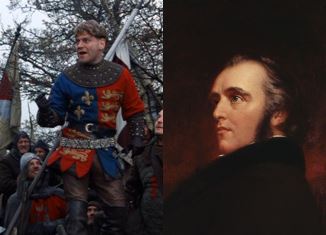
St. Crispin’s Day and Thomas Babington Macaulay’s Birthday

Henry V and Macaulay

Today coincides with both dates. As a tribute, let’s post both Shakespeare’s speech and something more reasoned by Macaulay.

Friday, October 16, 2015

Hypocritical Antisemitism

Karl Lueger

Update October 18, 2015: Concluding paragraph added.

One of Hitler’s inspirations was Karl Lueger, the Christian Socialist mayor of Vienna. Lueger had risen to fame and power through virulently antisemitic campaign speeches. But Lueger differed from Hitler.

Did Thomas Jefferson Rape Sally Hemings?

Thomas Jefferson

Hemings was Jefferson’s slave and as such could not decline his advances. In countless cases, slave owners used this power to force themselves on unwilling, nubile slaves. But is that what happened in this case?

Sunday, October 11, 2015

Fortuitous Coincidences

F

Update August 13, 2016: Some details in the below account are in need of correction. Please see this post.

Update: Added the interesting and somewhat disturbing footnotes 4, 5 and 6.

The author’s grandfather FPreviously mentioned here. spent a semester in the early 1930s as a visiting professor at the University of Berlin. There he made two acquaintances that the author must consider fortuitous for he most likely owes his existence to their combination. One of them was I, a clever and pretty post-doc of Junker blood, who in due course became his grandmother. The other was a medical researcher named Gerhard Domagk.

F eventually returned to Sweden with I. In 1935, I gave birth to A, the author’s mother.Previously mentioned here. In 1937, when A was two years old, she fell deadly ill with a bacterial infection. When the best efforts of current medicine failed to cure her, F telegraphed his friend Domagk. For Domagk was said to be working on a wonder drug to combat bacterial infection, today known as Sulfa-class antibiotics. Domagk couriered a sample from Berlin to F in Stockholm and A promptly recovered.

In 1939, the Nobel Prize Committee in Physiology or Medicine awarded Domagk the Prize. While Domagk surely deserved the Prize, one cannot help but wonder if the fact that F was a member, vice-chairman, and eventually chairman of many years, of the Committee and that Domagk had saved F’s baby daughter’s life may have accelerated the process.

Saturday, October 3, 2015

The Good News from Twentieth Century History

Evangelion

Being free; being rich; being secure from external enemies—these are all very good things. The great good news of twentieth century history is that these are not independent goods between which one might have to choose. Rather they flow from each other and mutually support each other in virtuous circles. So one could have reasoned from first premises: freedom leads to capitalism; capitalism leads to wealth; and wealth can be turned to military might, when the need arises. But each one of these steps is sufficiently contingent and uncertain that one might harbor reasonable doubts that conclusion always obtains but for the evidence of the great conflicts of the twentieth century which confirms that—at least at the current stage of technological and social development—it always holds.

Friday, October 2, 2015

Russian Soldiers Ate My Great-Grandfather’s Brains

russian WW2 soldiers

As a continuation of the recent series of posts on violence, family, brains, and eating,See Genius and Insanity, A Genuine Mystery, A Partial Explanation for a Genuine Mystery, and Human Sacrifice at the University. about a hundred years ago, the author’s great-grandfather—let’s call him S—was one the leading scientists in the fields of neurology and neuropathology.To judge from the accounts of family members and friends who knew him, S’s own brain was probably abnormal. At a scientific social event, he is reported to have turned to his wife and asked her why this colleague had suddenly walked away from them with such a ferocious mien on his face. His wife responded that this was probably because S had just called him an idiot to his face. To which S gravely nodded, yes, but it is true. This was apparently was typical of S and today he would probably be diagnosed with some high-functioning form of autism spectrum disorder.

Saturday, September 26, 2015

Sovereign Immunity as Irrebuttable Evidentiary Presumption

Thomas Wentworth, Earl of Strafford

The ancient doctrine of sovereign immunity to this day frequently shields the king’s men from legal liability for acts on his behalf. But this was not always how the doctrine was interpreted. Rather it was at times interpreted as an irrebuttable evidentiary presumption that the sovereign himself (i.e., the king) could not have formed a criminal intent. Under this view, the sovereign, no matter what the other evidence may say, will never be guilty of a crime.

It is in this form that the doctrine was on at least one celebrated occasion used not as a shield for a man of the king, but—in a gloriously perverse legal twistSo glorious that the author’s heart beats higher on reflecting that shares he with the authors of that twist the appellation of attorney.—as a deadly sword against a high-ranking king’s man.

Thursday, September 24, 2015

Ancient Liberties

Roundheads and Cavaliers

The Great Schism which, to this day, splits political views across the English-speaking world and elsewhere, first arose in England when technological and social changes, perhaps inevitable, threatened to make the king (or, to say the same, the government) over-powerful. Those who take the side of the king and government in this centuries-long struggle were called at times and places Royalists, Cavaliers, pre-modern Tories, Progressives, Socialists, or even, bizarrely as they are in today’s North America, Liberals—all of these terms map onto each other with reasonable, if imperfect, accuracy. Those who took the other side were called at times and places Anti-Royalists, Roundheads, Whigs, Liberals, or, equally bizarrely, Conservatives.This does make it particularly galling to hear the most successful leader of the Royalist side in the U.S. history denouncing the resistance as Economic Royalists.