
A Smithsonian Magazine article offers a periodic table of elements with each element marked by the country of first discovery. This occasions another moment of national pride.
A Smithsonian Magazine article offers a periodic table of elements with each element marked by the country of first discovery. This occasions another moment of national pride.


Sometimes people—even competent, intelligent people with responsible positions—just don’t know things one really would expect them to know. A recent incident reminded the author to be mercifully when judging those who exhibit such lacunae.

H was a non-Communist German Jew born in Eastern Europe in the early part of the twentieth century. As such, he had the honor that two of history’s great totalitarianisms made strong efforts to murder him and his family. Happily, they were not successful and after the war H was able to escape and become a professor of mathematical physics in the United States.
It was in that capacity that the author, then a newly enrolled student at H’s institution, first met H. H had at least two understandable reasons to take a dislike to the author. One is that the author always has been the most obnoxious of students; uncontrollably blurting out objections and questions on any subject which captured his interest and disturbing carefully constructed lesson plans. The other is that the author—a tall, blond, blue-eyed gentile and with an accent easily mistaken for German—must have born a superficial resemblance to one of the groups of people who had tried to murder him.
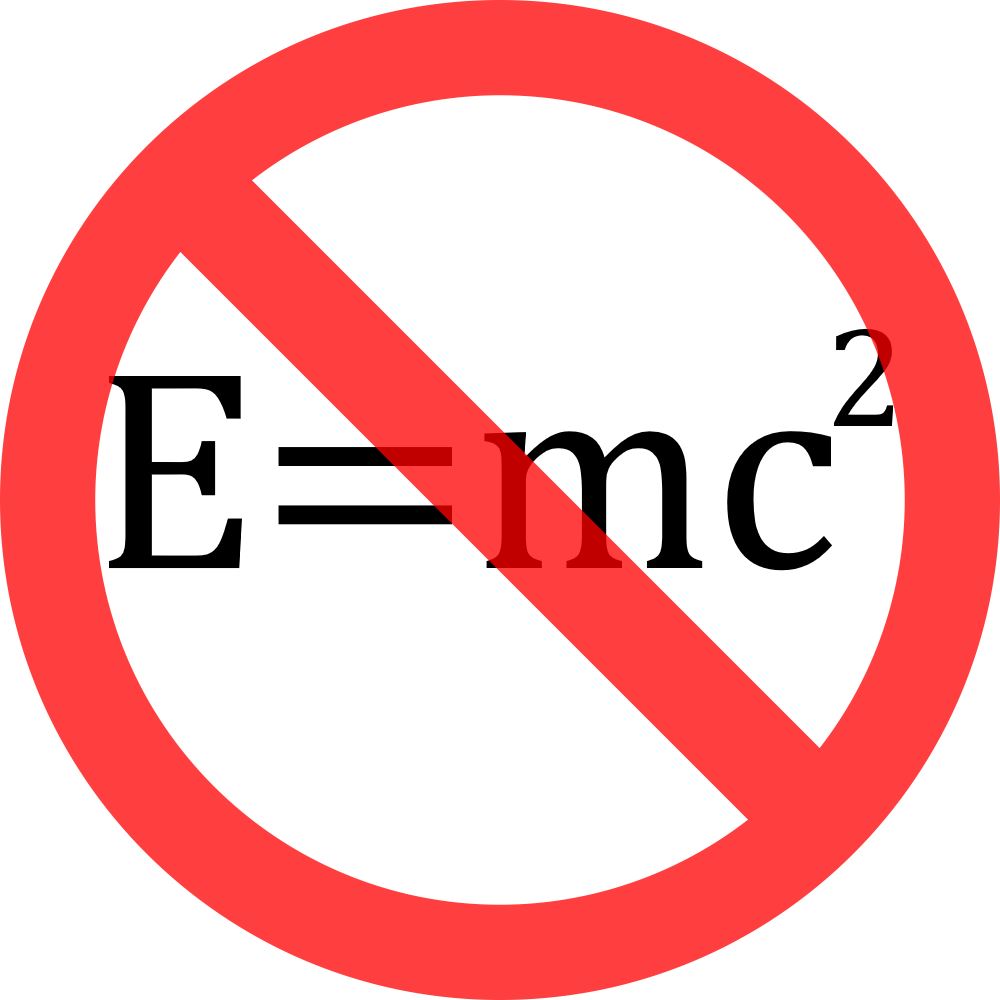
The titular formula is to many both the epitome and sum total of modern physics. It is regarded as the peak of human genius and the blueprint of the nuclear bomb.In some of these description, superlatives and awe seem to substitute for understanding. Surely, it covers blackboards in the lecture halls and offices of all reputable physics departments.
But surprisingly it does not. Even more surprising is the reason: this equation is universally agreed to be hogwash when the variables are interpreted in the way modern physicists find most convenient.That modern physicists know that \(c=1\) is a secondary reason for it merely renders the equation excessively verbose, rather than flatly wrong.

Update October 26, 2015: A very good Pop Physics/Mathematics lecture by Prof. Robbert Dijkgraf The Unreasonable Effectiveness of Quantum Physics in Modern Mathematics
is youtubed here. From about minute 19 to minute 22, Dijkgraf explains and offers some history on the theory discussed in this post, albeit without offering an answer to the reason the theory is rejected here. The whole thing is highly recommended as both accessible to the interested layman and offering some amusing details to the professional.
Note: This post contains a strong hint regarding the author’s proposed answer to a puzzle he once posted.
There is an amusing, if probably ultimately flawed, theory that seeks to explain the remarkable fact that of all the \(10^{80}\) or so electrons or so in the observable universe, every single one appears to have exactly the same mass and charge. Moreover, all the positrons (i.e., the electron’s anti-matter twin) also seem to have exactly the same mass and exactly opposite charge.

An article on pop physics, reportedly written by a retired Emory physics professor, is not entirely without merit or value, but it hangs itself of, and by, its subtitle question:
Light travels at around 300,000 km per second. Why not faster? Why not slower? A new theory inches us closer to an answer
To an interested layman this may seem a valid or even intriguing question. It is not.

One even somewhat familiar with the biographies of many of mankind’s greatest geniuses will be struck by the observation that an alarming fraction of them seem to have exhibited symptoms of mental illness, frequently quite severe. One need but think of Cantor, Frege, Nash, Landau, or Gödel.Newton’s name too probably belongs on this list.

One commonSee, for example, here for the usually much more astute Ilya Somin embracing this fallacy. trope of reporting on the scientific illiteracy of Americans goes something like this:
When surveys ask American adults to pick between the statements (A) the earth orbits around the sun and (B) the sun orbits around the earth, a large minority of about 25% pick statement B, rather than the correct statement A. This proves how shockingly ignorant many Americans are of scientific issues.
That conclusion may very well be true, but the argument proves no such thing; rather, it is merely sneering of the semi-educated at the honestly ignorant.

You have just made yourself a cup of tea. On top of this cup you have poured some milk. Now what?

Note November 9, 2015: Commenters jonshea figured out my proposed reason.
Note: A hint to the proposed answer for this puzzle is offered by another, more recent post here.
Large amounts of electrical power are generally transmitted via high-voltage lines. The reason for this is pretty basic: