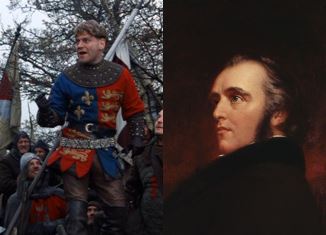
Today coincides with both dates. As a tribute, let’s post both Shakespeare’s speech and something more reasoned by Macaulay.
Today coincides with both dates. As a tribute, let’s post both Shakespeare’s speech and something more reasoned by Macaulay.


In its majestic equality, the law forbids rich and poor alike to sleep under bridges, beg in the streets and steal loaves of bread.«La majestueuse égalité des lois, qui interdit au riche comme au pauvre de coucher sous les ponts, de mendier dans les rues et de voler du pain.»
This quote of Anatole France’sThis page of the Nobel Laureate’s most famous quotes is well worth reading to the connoisseur of well-spoken lunacy. For example, it was not the Marquis de Sade, but France who said that Suffering—how divine it is, how misunderstood! We owe to it all that is good in us, all that gives value to life; we owe to it pity, we owe to it courage, we owe to it all the virtues.
is often cited as profound critique of the concept of neutral law applying equally to all without regard to status. It is said to rip the mask of hypocrisy from that notion and expose it for what it is: a mere rhetorical whip wielded by the 1% against the rest of us.
Just Write!
Common-place, yet one thought sound, advice frequently given to aspiring authors:
Just write! Put words on paper or screen and share them with whoever may be willing to read them.
Do not allow yourself to be worried about imperfection. For that will only ensure that you never write.
Perfection, should that ever become a necessity, can wait until such time.
Such advice is more readily dispensed than followed. But the volume and imperfection of these pages in recent weeks should attest that the author at least made a valiant attempt to do so.

There is a Straussian school of textual interpretation named after its founder, Leo Strauss, and which forms part of a larger framework of Straussianism.
At the core of Straussian interpretation is the insight, often forgotten by modern readers, that past thinkers, like Socrates, often lived under conditions which would have rendered some conclusions dangerous to state. The ruler or the religious establishment may take offense to some conclusions and punish the thinker should he openly state them, as indeed was the cause of Socrates' death.
This post requests the gentle and well-read readers' suggestions for fictions with a particular twist.
The fiction is most likely a short story or novel. It could be a movie, but due to the nature of the narrative that would be very difficult to do well. It is quite possibly genre fiction, most likely science fiction or mystery. As it relies on the trope of the unreliable narrator, it is unlikely to have been produced before the twentieth century.